
The case for backup internet has never been stronger — or cheaper to act on.
Most business owners think of an internet outage as an inconvenience. A few lost emails. Some frustrated staff. Maybe an hour of disruption before things get back to normal.
The reality is far more serious — and far more expensive.
The Internet Is Now Your Business Infrastructure
Over the past decade, the way businesses operate has fundamentally changed. Your phone system runs over the internet. Your accounting software lives in the cloud. Your team collaborates through Microsoft 365, Google Workspace, or Slack. Your customers pay through cloud-connected terminals. Your remote staff access everything through a VPN that depends on your office connection being live.
When the internet fails, it isn't just one system that goes down. Everything goes down. Simultaneously. And unlike the on-premises server rooms of old, there is no local fallback. The cloud requires the connection.
According to Flexera's 2025 State of the Cloud Report, 63% of SMB workloads are now hosted in the cloud — and that figure is climbing every year.
The Outages Are Real — and They Hit Every Major Carrier
This isn't a theoretical risk. In February 2024, AT&T suffered a nationwide outage that knocked out 125 million devices across all 50 states for nearly 11 hours. Over 92 million calls were blocked, including more than 25,000 attempts to reach 911. The FCC launched a formal investigation.
In July 2022, Rogers Communications in Canada experienced a total network failure that took approximately 25% of the country's entire internet infrastructure offline for up to 19 hours. Over 12 million subscribers lost connectivity. Canada's national Interac debit network went down with it — meaning businesses across the country couldn't process payments regardless of who their own internet provider was. The economic damage was estimated at $142 million CAD.
In May 2025, Bell and Telus suffered a multi-province outage in Canada during peak business hours, generating over 130,000 incident reports at its height.
The lesson from every one of these incidents is the same: no carrier, regardless of size or investment, is immune.
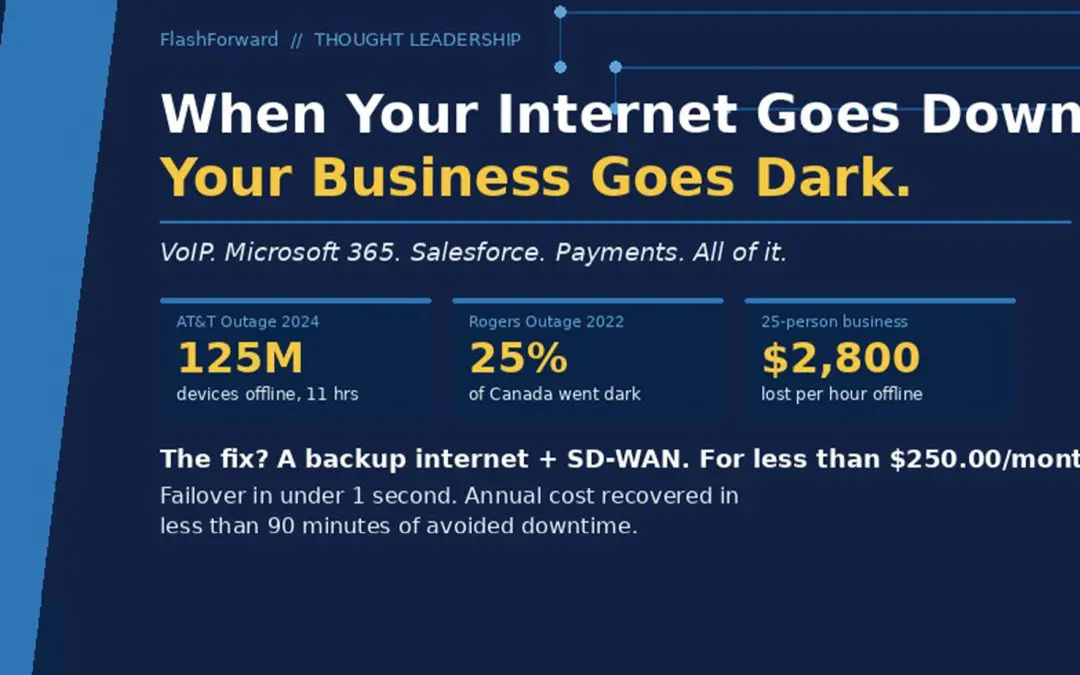
125M devices offline — AT&T outage, February 2024 — lasted 11 hours
25% of Canada's internet offline — Rogers outage, July 2022 — 12M+ subscribers affected
$142M economic damage (CAD) — Rogers 2022 — Interac debit down nationally
What an Outage Actually Costs Your Business
Industry research from ITIC puts the cost of downtime at over $300,000 per hour for most enterprises. But even at the small business level, the numbers are sobering.
For a 25-person business, a single hour offline costs an estimated $2,800 in lost productivity and foregone revenue alone — before emergency IT call-outs, customer churn, or any compliance exposure. A full-day outage approaches $22,000.
Add in the inability to process payments, the VoIP phones that go silent mid-call, and the remote staff who can't reach internal systems — and the real cost climbs further still.
For a 25-person business: $2,800 lost per hour offline. A full-day outage: approaching $22,000. Before a single IT support call is made.
The Fix Is Simpler — and Cheaper — Than You Think
A backup internet connection using a different technology and a different carrier from your primary service can be deployed for less than $250 per month, all-in. When paired with an SD-WAN router, failover happens automatically in under one second. Calls stay live. Cloud applications keep running. Your team keeps working.
SD-WAN — Software-Defined Wide Area Networking — is the technology that makes this seamless. Rather than sitting idle until disaster strikes, it continuously monitors both connections and intelligently routes your most critical traffic (voice, video, cloud apps) over the best-performing link at all times. The moment the primary link degrades, it moves traffic to the backup before any user notices.
For a 25-person business spending $250/month on a backup solution, the entire annual cost is recovered in less than 90 minutes of avoided downtime. For a 100-person business, that payback is measured in minutes.
Don't Forget Your Remote Team
Backup internet at the office isn't just about protecting on-site staff. If your business hosts any services on-premises — servers, phone systems, domain controllers, security appliances — your remote workers are directly exposed to every office internet outage, regardless of how good their own home connection is. A backup link at the office protects both cohorts simultaneously, at no additional cost.
The Bottom Line
Internet connectivity is now as critical to your operations as electricity. The good news is that protecting it costs a fraction of what a single outage will. A backup connection paired with SD-WAN is no longer the domain of large enterprises — it's accessible, affordable, and essential for any business that depends on the cloud, cloud communications, or remote access.
Which, in 2026, means virtually every business in North America.
Get the Full Special Report
FlashForward has published a full Special Report covering real outage case studies, a breakdown of backup internet technologies and pricing, SD-WAN explained in plain language, and ROI calculations by business size.
DM Dale Lyell directly on LinkedIn, or email Dale@flashforward.co to receive your free copy.